Introduction: Why Is the Huo Qubing AI Short Drama Getting So Much Attention?
The claims of “RMB 3,000, 48 hours, and 500 million views” quickly turned the Huo Qubing AI short drama into a talking point. But creators should look beyond the headline numbers. The real significance is that the project showed a wider audience how AI can take part in scripting, character design, storyboarding, and video production.
This kind of video does not appear after entering a single prompt. Story breakdown, character and environment design, storyboard planning, shot-by-shot generation, and post-production all affect the continuity of the finished piece.
This guide does not discuss broad industry trends or recreate an existing Huo Qubing video. Instead, we will make an original 60-75 second vertical historical short drama called Feng Qi Mobei. A young Han commander notices a decoy by studying a military report, the wind direction, and the position of signal fires, then changes course and marches north. You can follow the same method to turn your own historical inspiration into a story, characters, environments, storyboards, and video clips ready for generation.
What Is Actually Worth Learning from the Huo Qubing AI Short Drama?
Organize the script before generating video
Historical dramas often begin with the urge to show thousands of soldiers and horses. But a long shot packed with cavalry, banners, weapons, dust, and fast camera movement also increases the chance of distorted characters, misplaced horses, and unstable spatial relationships.
First, reduce the story to one decision that can be understood in 60-75 seconds. Build an opening hook, a clue, a reversal, and a suspenseful ending before generating visuals. The core of Feng Qi Mobei is not an entire battle. It is how a young commander realizes that a military report is false by reading the wind.
Lock the characters and environments first
A historical character is more than a face. The headpiece, hairstyle, armor plates, cape color, belt, and weapon can all drift from one shot to the next. Before generation, define five to seven visual traits that must never change, then establish the relative positions of the command tent, sand table, camp, and banners.
If you need complete front, three-quarter, and expression references, use the AI video character consistency guide alongside this workflow.
Give every shot one clear job
Each shot should advance one thing: deliver the military report, reveal the wind direction, complete the deduction, or change the marching route. When writing a storyboard, check whether the description includes these six elements:
Character + setting + shot size + action + camera movement + lighting
If one shot asks a scout to report, a deputy to urge action, the lead to reason through the clue, and the cavalry to depart, split it up. A storyboard does not need beautiful drawings, but it must answer, “What should the viewer learn from this shot?” For more help with the basics, read the AI video storyboard guide first.
Preparing an AI Short Drama: Our Feng Qi Mobei Example
Feng Qi Mobei is neither a biography nor a recreation of a specific battle. It is an original short drama inspired by the atmosphere of a Han frontier camp. The story focuses on one visual decision: a military report urges the troops to pursue west, but a young commander finds a flaw in the wind, signal-fire positions, and sand-table formation, then takes a dry riverbed north instead.
| Item | Setting for this project |
|---|---|
| Length | 60-75 seconds |
| Aspect ratio | 9:16 vertical video |
| Genre | Original historical war suspense short drama |
| Visual style | Cinematic realism, desaturated earth tones, cool blue dusk, dark red military banners |
| Lead | A fictional Han commander in his twenties: calm, decisive, and sparing with words |
| Central conflict | The report demands an immediate western advance, but the wind exposes a decoy |
| Ending hook | The cavalry turns north and the enemy appears from an unexpected direction |
The six scenes follow a progression of anomaly, report, suspicion, decision, action, and suspense:
| Time | Scene | Purpose of the shot |
|---|---|---|
| 0-8 sec | A military report lands beside the sand table as a candle burns one corner of the map; the lead pins the report down with a short sword | Establish the anomaly and hook immediately |
| 8-18 sec | A scout bursts into the command tent and reports three signal fires in the western valley | Deliver the military situation and time pressure |
| 18-31 sec | The lead studies the tent flap, military banners, smoke direction, and grains of sand | Let the audience see the clues behind the deduction |
| 31-44 sec | He moves the cavalry markers on the sand table and identifies the western signal fires as a decoy | Complete the reversal and change the route |
| 44-61 sec | Before dawn, the cavalry rides through blowing sand and takes the northern dry riverbed | Turn the decision into action |
| 61-75 sec | The enemy sees dust rising from another direction as a dark formation emerges ahead of the lead | End on a new threat and leave suspense |
This example works well for a first AI historical short drama because it has few characters and keeps its main locations within the command tent and camp. Viewers do not need prior knowledge of Han military history to understand the three essential beats: the report is wrong, the lead solves the clue, and the order changes at the last moment.
How to Make a Historical AI Short Drama
Huo Qubing is only one of countless historical figures who can inspire a story. Filming a traditional historical drama demands enormous time and labor, which makes it impractical for an individual creator who simply wants to explore a sudden idea. AI tools offer a useful alternative. Here, we will use SoulVid to make Feng Qi Mobei.
Establish the premise and opening hook
Open the SoulVid AI Drama Generator and enter the duration, aspect ratio, six scenes, live-action cinematic look, characters, environments, opening anomaly, and ending suspense. Do not write only “make a Huo Qubing short drama,” because the system would still have to guess whether you want a biography, a battlefield montage, or a fictional story.

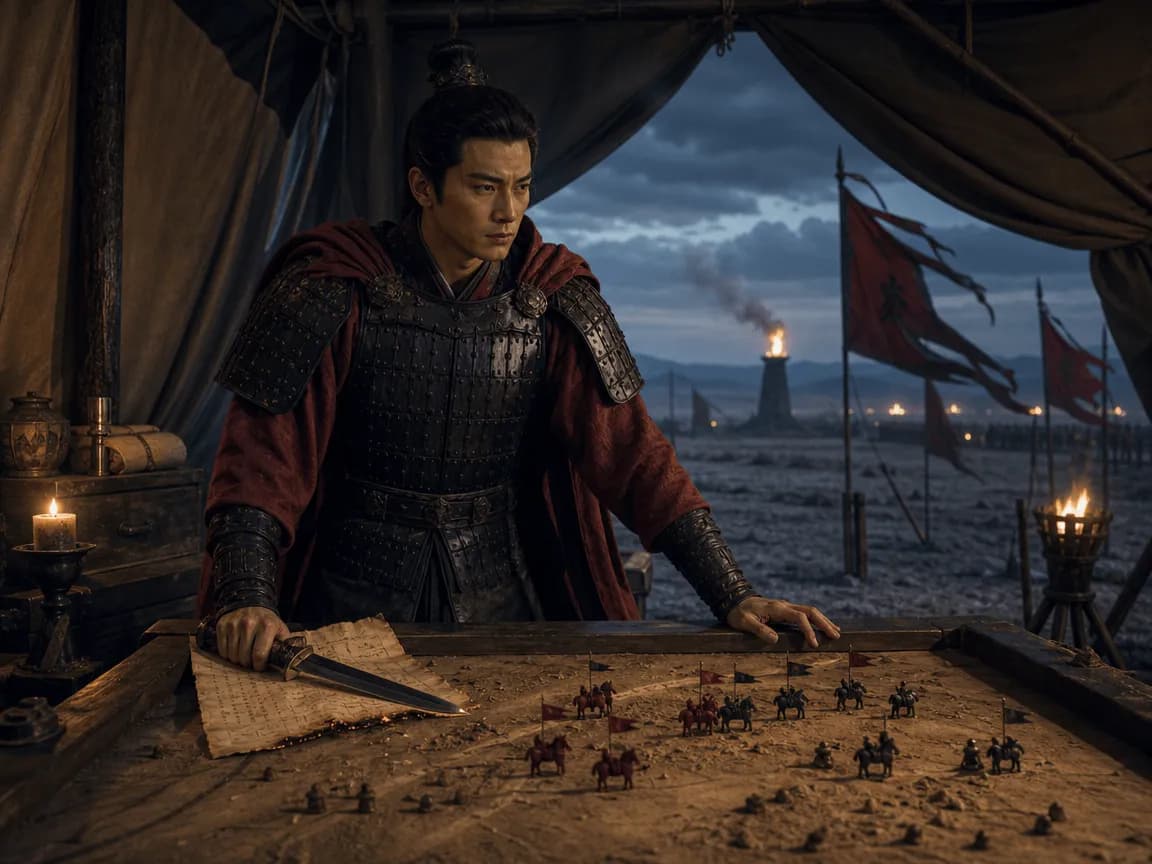
The damaged military report should appear within the first six seconds. This hook lets the audience see the sand table, short sword, candle flame, and the commander's judgment without requiring an opening voice-over.
Review the story plan generated by SoulVid
When the story plan appears, check whether its six beats remain in order: damaged report, scout's message, observation of the wind, movement on the sand table, cavalry departure, and the enemy noticing the dust. If the system adds an unrelated palace plot, romance, or battle backstory, ask it to remove those parts without rebuilding the effective settings.

You can write this when revising the plan:
Keep the current lead, command tent, wind clues, and ending. Remove only the palace and romance subplots. Keep the entire film at the same dusk, arrange the six scenes in causal order, and place the damaged military report within the first six seconds.
Lock character, costume, and environment anchors
The character card should lock the lead's face, headpiece, dark brown leather armor, dark red cape, and short sword. The environment card should lock the command tent material, sand-table position, entrance direction, candle stand, and camp banners. That way, viewers can still recognize the same person and world when the story cuts from a close-up inside the tent to the outdoor departure.
| Asset | Must remain fixed | Can change |
|---|---|---|
| Young commander | Lean face, tied headpiece, dark brown leather armor, dark red cape, short straight sword | Expression, stance, amount of movement in the cape |
| Deputy | In his thirties, broader face, dark gray armor, no cape | Facing the lead or the sand table |
| Command tent | Thick gray-beige fabric, wooden posts, central sand table, one low candle stand on the left | Camera position and shot size |
| Camp | Desert at dusk, dark red military banners, low tents | Density of soldiers and horses in the distance |
| Story props | Wooden sand table, red and black markers, short straight sword, damaged military report | Amount of wind moving the sand and paper |
Turn the six scenes into generatable shots
Every storyboard shot should specify shot size, character action, camera movement, lighting, duration, sound, and ending pose. First check whether the necessary information is visible, then decide whether the image looks impressive.
- Character: Does the lead still have the same face, armor, and cape?
- Orientation: Do the tent entrance, sand table, candle stand, and character positions connect with the next shot?
- Clues: Are the north wind, smoke direction, and sand-table positions enough to support the lead's deduction?
- Action: Does each shot contain only one main action?
- Ending: Can the gaze or pose at the end of one shot connect naturally to the next?
Generate and revise one scene at a time
Generate the opening shot of the falling military report first. Use it to check the lead, costume, props, color palette, composition, and subtitle safe area. Once that shot works, extend the sequence to the scout, wind clues, changed order, cavalry departure, and suspenseful ending.
If the character's face changes in one shot, revise only that shot's character reference or action description. If the command tent shifts position, correct only its environment anchors. Keep the shots that already work instead of rebuilding all six because of one deviation.
SoulVid also lets you use nodes to generate each segment separately, then assemble them into a complete short drama. That gives you much tighter control.
Add voice-over, music, subtitles, and pacing
Keep only short lines that move the story forward, such as “Three signal fires in the western valley” and “The western valley is bait. Take the northern dry riverbed.” Let the banners, grains of sand, sand table, and character reactions carry the remaining information.
Connect the scenes with wind, flapping tent fabric, hoofbeats, and low drums. Keep the subtitles in English and away from faces, sand-table clues, and the bottom of the frame where platform interfaces often appear. When the film is assembled, review the volume, pacing, and transitions across all six scenes so that each segment does not feel as if it belongs to a different musical mood.
Copy-Ready Prompts for an AI Short Drama
SoulVid story-planning prompt
Create an original 60-75 second, 9:16 vertical AI historical short drama with English subtitles titled “Feng Qi Mobei.”The story is inspired by the atmosphere of a Han frontier camp, but it is not a Huo Qubing biography and must not reproduce the character designs, dialogue, or storyboards of any existing short drama, film, or television series. Do not present fictional content as historical fact.
The lead is a fictional Han commander in his twenties. The story takes place in a frontier camp before dusk: a damaged military report lands beside a sand table, and a scout reports three signal fires in the western valley. By studying the north wind, smoke direction, tent flap, and grains of sand, the lead realizes the intelligence is false. He moves the cavalry marker on the sand table and orders the troops to abandon the western valley and take the northern dry riverbed. The cavalry departs through blowing sand. In the final shot, the enemy sees dust rising from an unexpected direction, leaving a hook for the next episode.
First output a one-sentence premise, a three-act plot, and six continuous scenes. Then list the characters, command tent, camp, and key props. Every scene must include duration, shot size, character action, brief dialogue, camera movement, lighting, sound effects, and ending pose. Show the damaged military report within the first six seconds and preserve a new threat at the end.
Use desaturated earth tones, cool blue dusk, and realistic cinematic photography. Do not add a palace or romance subplot. Do not include gore, modern objects, fantasy magic, floating text, brand logos, or the likeness of a real actor.
Character and environment consistency prompt
Lock the following character and environment settings. Across all six storyboard shots, only expressions, actions, shot sizes, and camera positions may change. Do not change faces, costumes, weapons, environment structures, or lighting direction.Lead: an original fictional young Han commander, age 23-27, with a lean but strong face, defined brow ridge, dark brown eyes, and black hair fully tied into a simple black headpiece. No facial hair. He wears layered dark brown leather armor, a charcoal crossed-collar inner robe, a dark red cape, dark cloth boots, and a short straight sword at his waist. His performance is calm and restrained, never shouting.
Deputy: in his thirties, with a broader face, dark gray armor, and no cape. He appears only in the military-report and sand-table decision scenes.
Command tent: thick gray-beige fabric and dark wooden posts. A low rectangular wooden table with a wooden sand table remains fixed in the center. There is only one low candle stand at the rear left. Through the entrance on the right, dark red military banners can be seen blowing southeast.
Camp: desert at dusk, low military tents, dark red banners, sparse cavalry, and horses. Keep desaturated earth tones and cool blue dusk light entering through the tent opening throughout the film. Do not include modern clothing, plastic, electric lights, modern architecture, or fantasy decoration.
Visual and motion prompts for all six shots
Shot 1 | Damaged military report | 0-8 sec
9:16 vertical close-up using the fixed command tent and sand table. A damaged military report lands beside three red markers, and the paper's corner catches fire from the low candle. The lead's short straight sword pins the report firmly in place. The camera slowly tilts up to his calm eyes. Keep only the sound of paper scraping, wind, and the flame. End on his suspicious expression.Shot 2 | Scout's report | 8-18 sec
Use the same command tent. In a 35mm medium shot, the north wind blows the entrance open and a scout strides in, drops to one knee, and reports three signal fires in the western valley. The deputy moves closer to the sand table while the lead stays still. Track smoothly from the entrance to the sand table and end on the three red markers.
Shot 3 | Reading the wind | 18-31 sec
In a 50mm medium close-up, the lead looks first at the tent flap and the military banners blowing southeast, then at the grains of sand on the sand table. Move smoothly from the banner to his eyes and finally to the smoke-direction marker. Keep the deputy silent in the background. End when the lead understands the clue.
Shot 4 | Changing the route | 31-44 sec
Begin with an overhead view of the sand table. The lead moves the cavalry marker away from the western valley and uses his short sword to trace the northern dry riverbed. He says, “The western valley is bait. Take the northern dry riverbed.” Lower the camera slowly from overhead to a side medium shot, keeping the sword, markers, and hands clear. End as the deputy nods and accepts the order.
Shot 5 | Cavalry departure | 44-61 sec
Use the same lead, costume, and dark red cape. From a medium-long rear three-quarter view of the camp at dusk, the lead mounts his horse and raises one hand. The cavalry turns in sequence toward the northern dry riverbed. Track steadily as the hooves lift a thin layer of dust, and keep every military banner moving in the same direction. No fighting, collisions, or rapid spinning. End as the riders enter the blowing sand.
Shot 6 | Suspenseful ending | 61-75 sec
Begin on a long shot of enemy scouts noticing dust rising from another direction. Cut to a medium over-the-shoulder shot behind the lead. As the blowing sand thins, a silent black military formation appears on the distant horizon. The lead rests one hand on the hilt of his short sword without beginning a fight. Move slowly past his right shoulder, hold for one second, then cut to black.
Common Failure Points in AI Historical War Stories
- Starting with thousands of soldiers and horses: Characters, horses, weapons, banners, and dust all move at once, so alignment errors multiply quickly. Begin with the sand table, report, and close-ups to establish the conflict.
- Armor, capes, and weapons keep changing: Put every immutable detail in the character card and avoid redescribing the entire costume with new synonyms in later shots.
- Character age, face shape, or hairstyle drifts: Confirm the character reference first and reuse it shot by shot. When revising, change only the action or camera position instead of rebuilding the person.
- Horses, banners, and character actions are too complex: Assign one main action to each shot and keep crowds in the distance moving in one direction.
- Too much dialogue leaves no time for visual storytelling: Keep military information and commands brief. Use reactions, props, sound effects, and subtitles for everything else.
- Fiction is presented as real history: Label the release as an “original short drama inspired by history,” “fictional interpretation,” or “AI concept film,” and verify real people and events separately.
FAQ
Was the Huo Qubing AI short drama really completed for RMB 3,000 in 48 hours?
Can a beginner make an AI historical short drama?
How do I keep a character's face consistent across scenes?
Can I directly use Huo Qubing's name and likeness?
Should a historical short drama use a live-action or animated style?
How many scenes should an AI short drama have?
Conclusion: The Workflow Matters More Than Any One Model
Popular examples can inspire you, but the reusable lesson is the workflow: define the boundary between history and fiction, reduce the story to one high-tension decision, and lock the characters, environments, and props. Only after the storyboard works should you spend generation credits on the clips that matter.
The core of an AI historical short drama is not recreating a famous battle. It is letting the audience see, within 75 seconds, how one person reads a trap in the wind. Once that moment works, the historical atmosphere, larger spectacle, and serialized story have room to grow.
Create Your First AI Historical Short Drama with SoulVid
Turn one historical idea into a story, characters, and six storyboard shots, then generate the shots worth keeping one by one.
Open the SoulVid AI Drama Generator